01 What does a brew day ask of cloth?
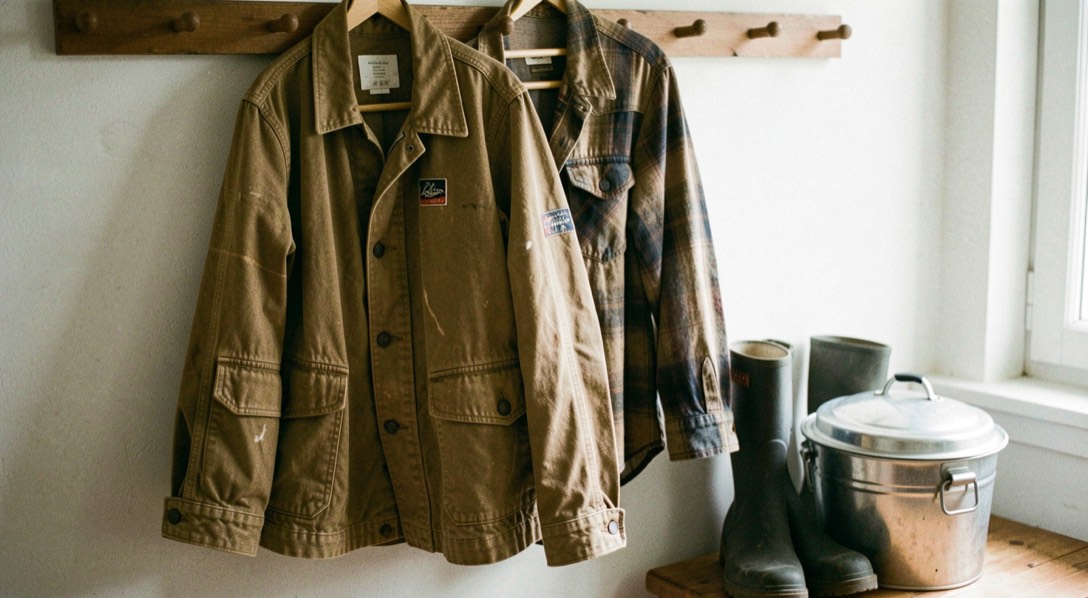
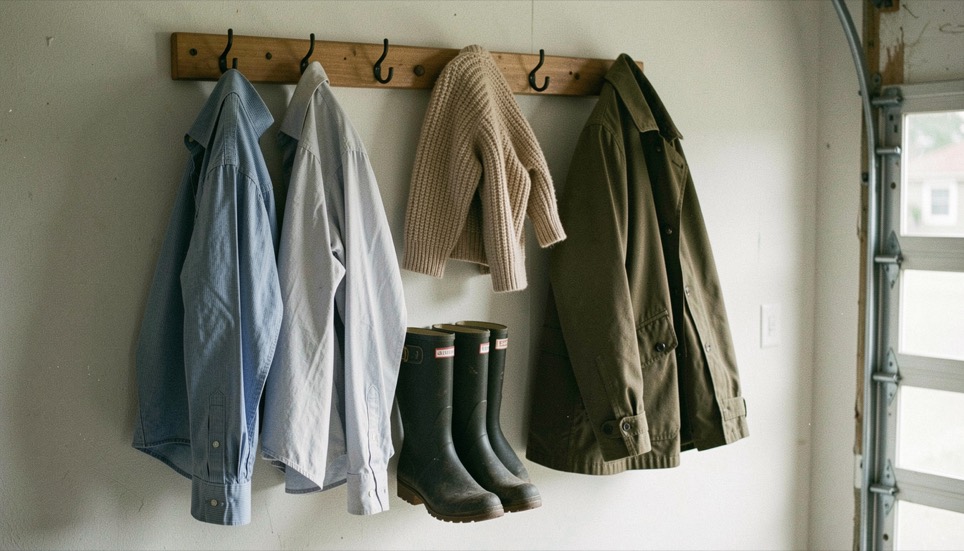
A brew day wants a short rail of clothes you can stop thinking about: trousers that take a splash of caustic cleaner, a shirt that does not mind steam, a jacket that shrugs off a cold garage, and boots that forgive a wet floor. Four or five pieces, all washable, each earning its hook. Anything that needs protecting from the work is the wrong piece, however good it looked on the hanger.
The arithmetic of a small wardrobe is a practised craft outside the brewhouse too. Get Real Clothes, an independent wardrobe magazine, works through the same questions on its own pages: building a capsule wardrobe from fewer and better pieces, evaluating a clothing brand beyond its sustainability page, keeping a personal uniform that removes daily decisions, and dressing for an actual climate rather than the season the shops are selling. The brew room version is simply that advice with wort on it.
02 Why does a small rail beat a big cupboard?
A capsule rail is not austerity, it is removal of decisions. One silhouette and three quiet colours mean every shirt works with every trouser, so the six in the morning choice disappears and the attention saved goes into the kettle instead. The brewer who dresses by uniform never stands at the rail awake before the water is, which is the whole point of keeping one.
The principle is already familiar from the tin shelf: a printed kit recipe is a known quantity that frees the evening for execution rather than debate, the same trust we place in a printed kit recipe when the instructions outrank improvisation. A working wardrobe applies the identical shortcut to cloth, chosen once and then simply worn until it retires.
| Piece,Job it does,When it earns retirement | ||
|---|---|---|
| Work shirt | Shields skin, dries overnight | Collar gone soft or torn |
| Canvas trousers | Take kneeling and splashes | Knees white and thinning |
| Waxed jacket | Garage cold and yard rain | Reproofing stops holding |
| Rubber boots | Wet floors and spilled wort | Sole split or perished |
| Wool jumper | Static warmth for indoor spells | Elbows through beyond darning |
03 How do you judge a maker past its own page?
A sustainability page is written by the brand it describes, so read it the way this magazine reads a wine label: what is claimed, what is measured, what is left silent. Fashion Revolution publishes an annual transparency index that reads large brands against what they actually disclose rather than what they advertise, which is the closest thing clothing has to a published gravity reading.
Evidence outranks adjectives in the small details: a maker that publishes fabric weights, stocks spare buttons and writes a repair policy is making claims it can be held to, the same rule our piece on reserved label words borrows from German wine law. A jacket that cannot be reproofed or a boot that cannot be resoled was never really workwear at all.
04 Dressing for the room you brew in
The actual climate of a brew day is not the season on the calendar but the room on the thermometer: a British garage in March, a steamed kitchen in August, the garden tap in October. Dress for the coldest half hour and peel layers as the kettle warms the space, and choose cloth that dries by morning because brew day comes round weekly.
Washing rhythm matters as much as fabric: working clothes that can be washed hard, line dried overnight and worn again without ceremony outlast delicate alternatives many times over, and the wardrobe that launders simply gets worn more honestly. Brewers weighing a longer absence from the kettle can carry the same few-pieces logic further in our notes on a long stay abroad, where the bag has to last two years rather than one afternoon.
Quality in a loaf starts long before the oven. Grain is grown, stored, milled and baked, and each step leaves its mark on the finished bread. The same logic applies to eggs, where feed, housing and handling decide what reaches the kitchen. Control usually sits with different bodies at different stages, and certification schemes vary in what they actually verify. For a small producer or a home brewer, the useful question is which checks change the product and which only change the label. A closer look at field to product quality in the Italian food chain sets out how that works for bread and eggs.
Scaling a brew day for a crowd follows the same logic as scaling a recipe: work from a fixed number and let every other figure fall out of it. Plates, glasses and cutlery are counted per head, with a margin for breakages and second helpings. Menus are then built around the equipment you actually have, often one cold oven, rather than the other way round. Food is portioned by weight or volume, and anything held before service needs a safe temperature and a clear time limit. A guide to quantities per guest and safe holding covers the same ground for a hundred covers, and the arithmetic transfers to a brew day buffet without much adjustment.
A beer or wine can be judged in the same way as a wine label, by what the liquid itself shows rather than what the packaging claims. Acidity, alcohol, extract and the choice of wood or steel all leave a signature in the glass, and that signature is often a truer guide to where a drink comes from than any printed region. For a closer look at how this works in practice, particularly with riesling and the Schwarzriesling branch of the burgundy family, see this piece on reading origin in the glass. The same habit of attention pays off when you taste your own brews.
Brewing and farmhouse cooking share the same habit of working with what the season gives you. A brewer reading about Vaud farmhouse cooking will recognise the approach: simple dishes built on long simmering, salt, and patience rather than on technique for its own sake. The same restraint applies to chasselas, a wine that is served young and dry and does not ask to be cellared for years. If you want to see how the cooking, the route through the district, and the wines fit together, there is a practical guide to Vaud farmhouse cooking that sets out the dishes, the cellars, and where to buy the bottles.
A Negroni lives or dies on balance, and balance is a matter of measurement rather than mood. Bitterness from the gin and the bitter aperitivo, sweetness from the vermouth, and dilution from the stir all pull against each other. Too little dilution and the drink reads hot and syrupy; too much and it turns thin. The same arithmetic governs the aperitivo hour, where a short, bitter drink is meant to open the appetite rather than close it. For a closer look at how those three forces are tuned, and at how vermouth and sparkling wine are chosen and kept, see this piece on aperitivo and Negroni balance.
Cord work on brew kit is mostly a question of matching the fixing to the load. A bowline holds a steady pull without jamming, a round turn and two half hitches takes a changing one, and a splice keeps more of the cord's rated strength than any knot can. Braiding follows the same logic: a lanyard, a key fob or a dog lead is only as good as its construction, and the inner strands usually fail before the outer sheath does. For a fuller treatment of paracord knots and braids, including which knots cover most jobs and what strength ratings really promise, that article sets out the detail.
An assessment of open space starts with a defined study area and a list of what counts as provision: parks, playing fields, allotments, natural green space. Surveyors visit each site and record size, condition, access points and facilities, then audit the results against local standards. Catchments are mapped by walking distance from each site, which shows who can reach green space and who cannot. The final report sets out the findings and the gaps. A worked example of how a PPG17 open space assessment was done, from survey through to mapping, is set out in one English article, and it is worth reading if you want the method rather than the summary.
05 Desk margin notes
Retirement deserves its own ceremony on the rail. A shirt leaves service when the collar goes, not when fashion coughs, and the mend basket catches everything earlier: a button, a seam, a wax dressing renewed in front of the stove. Ten minutes with a needle returns a garment to duty more often than any replacement trip manages.
Replacements come cheapest where nobody poses them. The charity rail and the end-of-line bin both reward the same examination: cloth in the hand, seams inside out, weight where weight belongs. A jacket judged that way costs a tenth of its ticketed life and carries no marketing department's promises to disappoint you.
Keep the rail's ledger beside the brewing one. What wore out, after how many washes, and which seam failed first is the same habit of small honest figures that keeps a fermenter truthful, only pointed at cloth. A rail that is written down never quietly refills itself.
One rule settles most arguments before they start: nothing enters the rail that cannot be washed hard and dried overnight. Apply it at the shop rail, not at the peg, and the wardrobe keeps itself without a single spreadsheet or seasonal clear-out ritual.