01 How many plates and glasses does a table of a hundred actually need?
A table of a hundred needs roughly 130 to 150 plates and 200 to 250 glasses in circulation, not one hundred of each. The extra covers breakages, second helpings and the stack sitting in the wash. Everything else follows from the same logic: count in tens, plan the oven before the menu, and treat cold storage as the constraint that decides what you cook.
Start from the number of courses, then add a working margin. For a single main course served at the table, 120 to 130 dinner plates covers a hundred guests: ten per cent for breakage and ten per cent held back for late arrivals or a dropped plate. Add a side plate per guest if bread or salad is separate, so another 110 to 120. If you serve a starter and a dessert, you are not doubling the count, you are cycling the same plates through the wash, which only works if you have the time and the staff to turn them.
Glasses are counted differently because guests keep them. Budget two per person for water and wine, and three if there is a toast or a soft drink on the table. That is 200 to 300 glasses, and the practical figure is closer to 250 because they get moved, mixed up and broken. Water glasses stay on the table; wine glasses get topped up, so you need fewer of them in circulation at any one moment than the total suggests.
Cutlery follows the same arithmetic: one set per course per guest, plus ten per cent. Dessert spoons are the ones people forget.
The counting method matters more than the exact number. Work out how many items are on the table at the same time, how many are in the wash, and how many are in reserve. If those three figures add up to more than you own, you hire, borrow or simplify the menu. A buffet that circulates removes the plate problem almost entirely, because guests reuse one plate and you only need 120 to 150 in total rather than a fresh one per course.
The same discipline applies to the food itself. Working out quantities per guest before you shop is what stops a hundred-cover meal turning into guesswork at the till.
03 How much food per guest, and how do you hold it safely until service?
Quantities per guest depend on the dish, but a working set of figures covers most shared tables. Allow 200 to 250 g of protein per guest for a main course, 250 to 300 g of starchy side, and 150 to 200 g of vegetables. For a buffet where guests serve themselves, add ten to fifteen per cent, because people take more when the portion is not fixed. Bread runs at 80 to 100 g per guest. Salad leaves, 60 to 80 g. Dessert, 100 to 120 g.
These figures assume one main course. If you serve two proteins, reduce each rather than adding them together.
Holding food safely from market to service is a chain, and every link has a temperature. Cold food stays below 5°C, hot food above 63°C, and the danger zone between them is where bacteria multiply. The practical rules for a hundred covers are these:
- Shop with cold storage in mind. Take cool boxes and ice packs, and go to the market last, not first.
- Refrigerate within two hours of purchase, and sooner in summer.
- Cook ahead and cool fast. Spread hot food in shallow trays and get it into the fridge within ninety minutes.
- Reheat once, to 75°C throughout, and do not reheat twice.
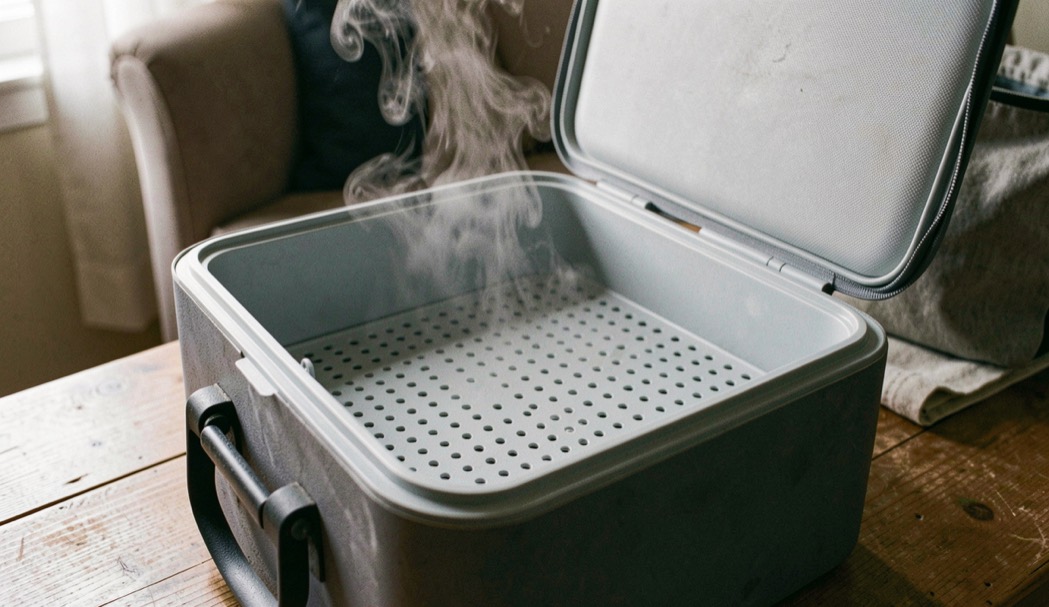
- Hold hot food in insulated boxes or on a heat source, and check the temperature with a probe, not by hand.
- Keep cold dishes on ice or in the fridge until the moment they go out.
- Never leave food sitting out for more than two hours in total, including service.
For a hundred guests, the bottleneck is fridge space, not cooking skill. Two domestic fridges will not hold a hundred portions of everything. The answer is to choose dishes that keep well, to cook in batches across two days, and to use cool boxes with ice as overflow storage, checking temperatures as you go.
04 What changes when the table is a buffet rather than a served meal?
A buffet that circulates removes the plate-per-course problem and reduces the crockery count to one plate and one set of cutlery per guest, plus reserve. It also changes the food quantities, because self-service portions are larger and less predictable. Add ten to fifteen per cent to every figure above.
The trade is that buffet food sits out longer. Keep hot dishes in chafing dishes or insulated containers and replace them in small batches rather than putting everything out at once. Cold dishes go out in shallow trays that can be swapped, not in one deep bowl that warms from the outside in.
Service at the table uses fewer serving dishes but more staff time. Buffet uses fewer staff but more equipment and more food. Neither is better; they cost differently.
05 How do you plan the day itself?
Write a timetable with times, not tasks. Market in the morning, cold storage by midday, cooking in the afternoon, cooling in the evening, reheating and plating in the last hour. Build in a gap before service, because something will run late.
Count backwards from the serving time. If the main goes out at eight, the oven has to be free by seven, the trays loaded by half past six, and the food out of the fridge by six. That is the whole method: fixed numbers, a cold oven treated as a limit, and temperatures checked rather than assumed.
For readers weighing how a long menu fits a single service, the cooking of Vaud offers a useful model. Its farmhouse dishes are built to be prepared ahead and held without losing character, which suits a hundred covers better than most restaurant food. The wines that accompany them, chiefly chasselas, are equally forgiving at table. A guide to Vaud farmhouse cooking sets out the classic dishes, a gourmet route through western Lausanne, and the cellars where the matching bottles are bought. Read it before fixing a menu, then apply the same holding and timing rules set out above.